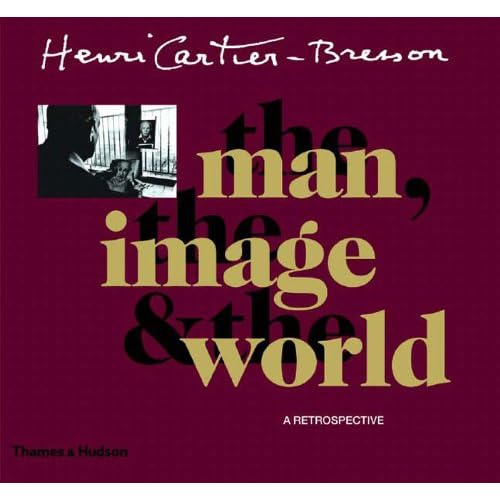
Henri Cartier-Bresson: The Man, the Image & the World: A Retrospective
Category: Books,Arts & Photography,Photography & Video
Henri Cartier-Bresson: The Man, the Image & the World: A Retrospective Details
Amazon.com Review Henri Cartier-Bresson spent four decades traveling the world as a photojournalist in search of what he called "the decisive moment"--the instant when visual harmony and human significance coalesce. Published in honor of his 95th birthday, Henri Cartier-Bresson: The Man, The Image & The World is a handsome volume that reproduces more than 600 photographs, film stills, and drawings and includes essays by art, photography, and film experts. Trained as a painter in his native France, Cartier-Bresson began his photography career during a trip to the Ivory Coast in 1931. After shooting his way through Europe, Mexico and the U.S., he became an assistant to filmmaker Jean Renoir and directed documentaries in support of the Spanish Civil War. Imprisoned by the Germans during World War II, he escaped to document the liberation of Paris. More than a quarter-century of magazine photography followed—-including vivid glimpses of modern life in India, China and the Soviet Union—-before he put aside his camera in favor of his sketchbook. Cartier-Bresson's ability to capture peak moments resulted in unforgettable single photographs, like that of a woman in a group of former concentration camp prisoners who suddenly recognizes her Gestapo informer and reaches out to hit her. His constant watchfulness led to images that capture fleeting emotion—-lust, pride, despair, expectation, glee—-on the faces of people going about their daily lives in grim cities, sleepy villages, and vast landscapes. Shaped by compassion and a self-effacing absence of personal judgment, these photographs reflect a worldview no longer fashionable but forever relevant to human understanding. —Cathy Curtis Read more From Publishers Weekly Cartier-Bresson's photos of everyday scenes were apparently bothersome to an audience accustomed to the abstract work of Steiglitz and Strand. But his snapshots were a new and powerful way of documenting the world: an astrologer in 1947 Bombay; a 1967 control room at Cape Kennedy, Fla.; a 1954 "sports gala" in Moscow. He "improvised, incorporating the effects of chance and accident as he went along," writes Philippe Arba‹zar of the BibliothŠque Nationale de France in an essay called "The Public Eye: Shows and Exhibitions." Saul Steinberg even made him a fake diploma authorizing Cartier-Bresson to become a photographer, as if his work needed legitimacy. With quotes from MoliŠre, Virgil, Verlaine ("Memory, memory, what do you want of me?") punctuating the chapters, and more than 600 of Cartier-Bresson's photographs and even drawings, films and books, this is indeed a comprehensive and stunning retrospective, carefully printed and showing the huge oeuvre's variations. Complemented by essays by Peter Galassi of MoMA and Serge Toubiana of Cahiers du Cin‚ma, among others, the book coincides with the opening of the Henri Cartier-Bresson Foundation in Paris, as well as the photographer's 95th birthday. Copyright 2003 Reed Business Information, Inc. Read more Review This is indeed a comprehensive and stunning retrospective, carefully printed and showing the huge oeuvre's variations. -- Publishers Weekly, 28 April 2003 Read more


Reviews
First of all, I am surprised with the size and quality of the book. It is not hardcover, but the cover jacket is very well made. All pages are black and white, good quality art paper. The book consists of most Henri Cartier-Bresson works from 1930's to 70s. Amazingly it also consists of his work (painting and drawing) after he retired as photographer. It also has some interesting critiques and commentaries from his friends and scholars.For people who does not know Henri, he is regarded as the father of street photography and photojournalism. He is one of the founder of highly respected Magnum photo agency. During his life, he works for magazine such as LIFE, Harpers Bazzaar, Vu, Regards, etc. In 1950, he wrote about his photography philosophy of Decisive Moment which means not only means capturing the significant moment, but also must be presented in the most artistic composition.This is by far the most complete book about Henri Cartier-Bresson that I ever read, and I highly recommended for everybody who is interested on pursuing photojournalism or admirer of his body of work and life. Please check out more review at my blog radiantlite dot com.